Kit Ring
Product design • Game design
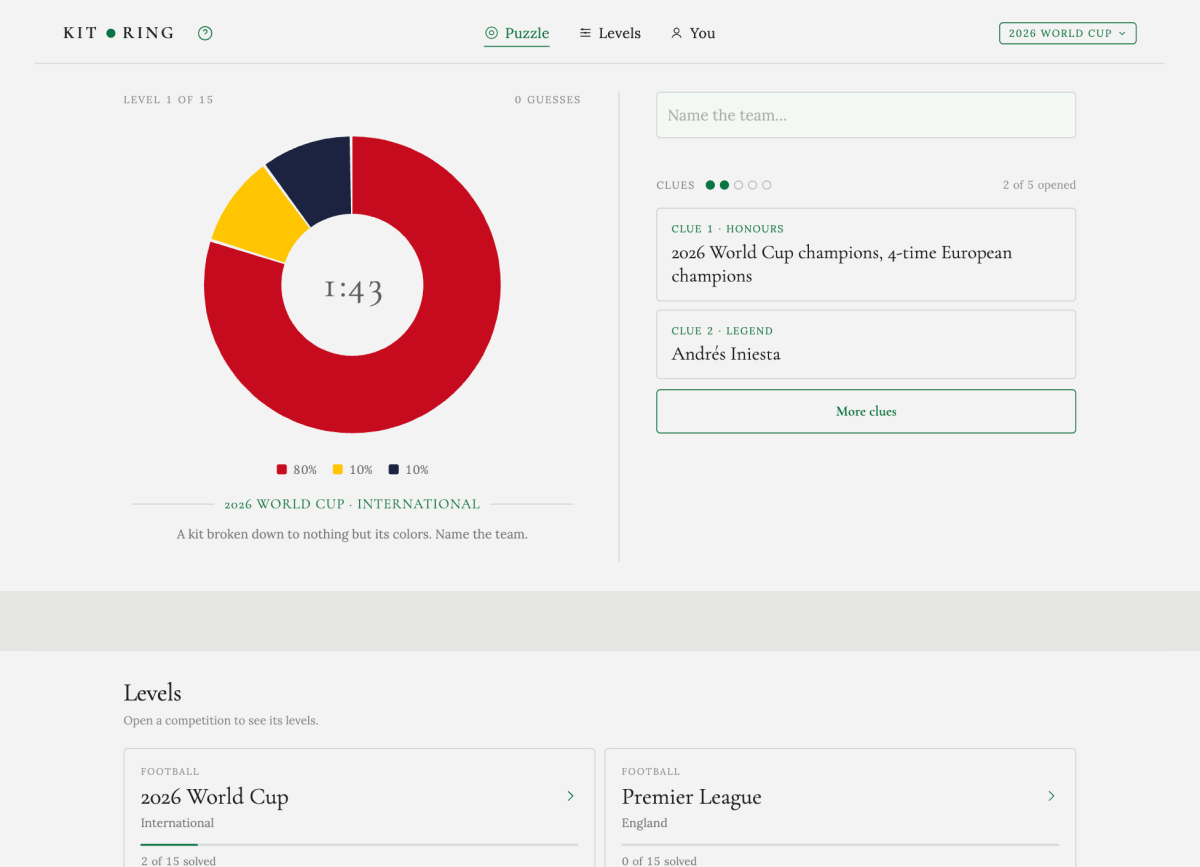
Kit Ring is a puzzle: a football kit reduced to nothing but its colours, and you name the team. I designed and built it end to end over the 2026 World Cup season, largely to find out what is left of a design problem when the only material you keep is colour.
Company
Personal project
Role
Designer and builder, end to end
Year
2026
Background
I wanted to explore building a small, self-contained game outside of work — something with a tight, replayable loop of the kind Wordle established, but built around a niche I am actually interested in: football kits and team identity.
The 2026 World Cup gave it a natural hook and a moment of cultural relevance to build around. A subject with a tournament behind it does some of its own marketing through relevance and shareability, and the tournament is also a frame, which kept the scope from wandering.
Design Strategy
The core design challenge was reduction: taking something as visually rich as a football kit — crests, sponsors, patterns, typography — and stripping it down to nothing but colour, while keeping it solvable for fans who know their teams well. Most of the iteration went into how much colour information is "enough". Too little and the puzzle is a guess with no signal; too much and it stops being a puzzle at all.
Rather than settle that with a single static clue, I designed the core loop around progressive disclosure. Players start with just the colour ring and can choose to reveal additional clues one at a time, trading information for difficulty — which lets the game self-adjust to a player’s own football knowledge instead of forcing one fixed difficulty on everyone.
Around the puzzle sit three simple views — Puzzle, Levels, and You — mirroring the pattern daily word games use to earn habitual play: one daily challenge to keep the barrier to entry low, a levels and archive structure for players who want more than one puzzle a day, and a personal stats view that gives a streak somewhere to live.
Result
Live and playable, with a working puzzle loop, level progression, and personal stats tracking.
Self Reflection
Building something end to end outside a work context — concept to shipped product — meant making fast calls with no team to validate every decision. That is a different muscle from arguing a decision through review, and I was rustier at it than I expected to be.
It also confirmed something I only half believed: a hard constraint, here just colours, produces a more interesting design problem than an open-ended one. There was no room to solve it by adding.